
There is something happening in modern physiotherapy that, in our view at On Path Physio, deserves a conversation.
Physiotherapy has become increasingly focused on exercise-based rehabilitation — and for good reason. Exercise is powerful. It can improve strength, capacity, confidence and function, and it should absolutely be part of the rehabilitation toolkit for many musculoskeletal conditions.
But somewhere along the way, we believe some physiotherapists have started to lose one of the things that made physiotherapy so valuable in the first place:
The power of touch.
The hands-on assessment.
The ability to feel how a joint moves.
The ability to identify areas of soft-tissue restriction.
The ability to use manual therapy to reduce pain or improve movement.
And perhaps most importantly, the ability to combine all this clinical information with exercise and education to create a truly individual treatment plan.
At On Path Physio, we don’t believe the choice should be manual therapy OR exercise.
We believe good physiotherapy is often manual therapy AND exercise alongside education, movement retraining and a clear understanding of what is happening to the individual patient.
Exercise is important. But is exercise alone enough?
Imagine someone comes into the clinic with a painful shoulder.
They have difficulty lifting their arm above their head. Their shoulder is stiff. Their upper back is restricted. Their surrounding muscles are tight, and they have been avoiding certain movements because they hurt.
One approach might be to prescribe a series of strengthening exercises and send the patient home.
There is nothing inherently wrong with that.
But what happens if the patient can’t move well enough to perform the exercise correctly?
What happens if pain prevents them from loading the shoulder?
What happens if the movement restriction hasn’t been addressed?
What happens if they don’t understand why their shoulder is behaving this way?
This is where hands-on physiotherapy can have an important role.
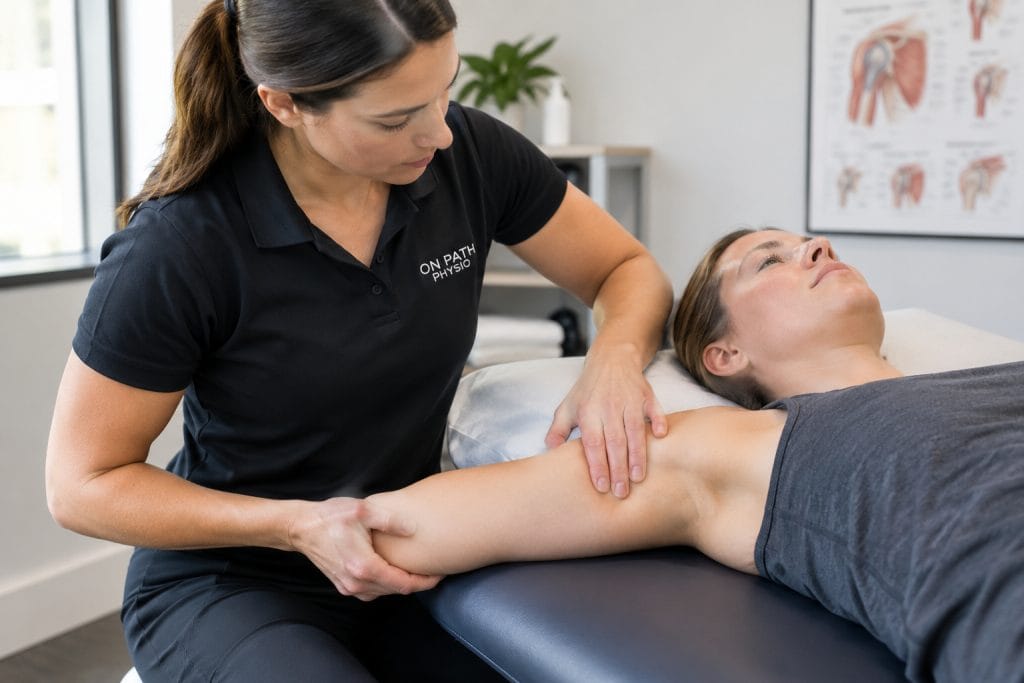
A skilled physiotherapist can assess the movement, identify areas of restriction and use appropriate manual techniques to help the patient move more comfortably.
Then the exercise becomes more meaningful.
Instead of asking the patient to repeatedly exercise through a movement they cannot perform well, we can first work on the factors limiting that movement and then reinforce the change with active rehabilitation. That is where the combination becomes powerful.
The body is not just a set of muscles that need strengthening
One of the concerns we have with an increasingly exercise-dominated approach is that musculoskeletal problems can sometimes be reduced to:
“You’re weak. You need to strengthen.”
But the human body is considerably more complicated than that.
Pain can alter movement.
Joint stiffness can change muscle recruitment. Soft-tissue restrictions can influence how a joint moves.
Protective muscle guarding can develop following injury.
Previous surgery can change movement patterns.
Poor thoracic or cervical mobility can influence shoulder function.
Hip mobility can influence the lower back and knee.
And sometimes a person simply needs a skilled clinician to put their hands on the area and assess what is happening.
This doesn’t mean that every painful area needs to be massaged or mobilised.
It means that manual assessment and manual therapy remain valuable clinical tools.
Touch provides information
One of the most underrated aspects of manual therapy is that it isn’t simply about “loosening muscles.” Touch provides information.
A physiotherapist can feel differences in tissue tension, joint movement, tenderness, guarding and asymmetry that may not be obvious from watching a patient perform an exercise.
That information contributes to clinical reasoning. For example, a patient may report knee pain during a squat. Rather than simply prescribing squats, a physiotherapist can assess:
- How the ankle is moving
- How the hip is moving
- How the knee is tracking
- Whether there is soft-tissue restriction
- Whether the patient is avoiding loading one side
- Whether there is joint stiffness
- How the pelvis and trunk are contributing
- What happens when the restricted areas are treated
That is physiotherapy. The exercise is the tool. The clinical reasoning is what makes the tool appropriate.
Manual therapy isn’t magic
It is important to be clear about this.
At On Path Physio, we don’t believe manual therapy is a magical technique that “puts everything back into place.”
Nor do we believe every musculoskeletal problem requires hands-on treatment.
The evidence for manual therapy varies depending on the condition, and it should not be presented as a universal solution. Modern rehabilitation appropriately places significant emphasis on active interventions, including exercise. The World Health Organization’s rehabilitation resources for musculoskeletal conditions include both exercise-based interventions and manual therapies within the broader rehabilitation toolkit. (World Health Organization)
Physiotherapy was never supposed to be one-dimensional
Physiotherapists are fortunate to occupy a unique position within allied health.
We can assess movement, examine joints, assess muscle function, use our hands, prescribe exercise, educate, modify activities, retrain movement and we can help someone return to work, sport and everyday life.
That is the strength of physiotherapy.
At On Path Physio, we sometimes describe this as being a “jack of all trades” within allied health not because physiotherapists should attempt to do everything, but because our profession has historically brought together multiple clinical skills.
We don’t want to lose that breadth.
Research should absolutely influence physiotherapy practice.
But evidence-based physiotherapy should not mean:
“If it isn’t an exercise, we shouldn’t do it.”
Evidence-based practice is broader than that. It means combining the best available evidence with clinical expertise and the individual patient’s circumstances, preferences and goals.
The hands of a physiotherapist still matter
There is also something deeply human about being treated by another person.
When someone has been in pain for weeks or months, they often don’t just want a list of exercises.
They want someone to examine them, listen, explain what might be happening and they want someone to put their hands on the painful area and help them understand their body.
They want to know:
“Why does this hurt?”
“Why can’t I move properly?”
“What can we do about it?”
And sometimes, after appropriate assessment and treatment, they discover something incredibly valuable:
“I can move further than I thought I could.”
That moment can change how someone approaches rehabilitation.
Manual therapy can be the bridge to exercise
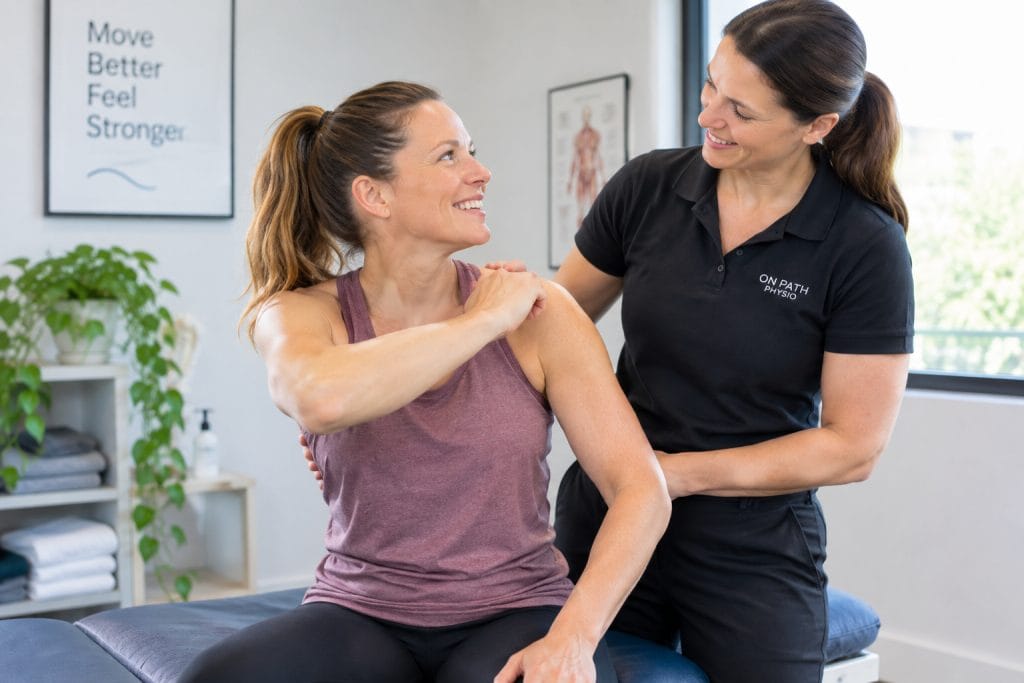
Perhaps the best way to think about manual therapy is not as the competitor to exercise, but as a potential bridge to exercise. A stiff shoulder may need mobility work before strengthening becomes comfortable. A painful knee may need symptom modification before someone can confidently load it.
A restricted thoracic spine may need mobility work before a patient can perform their shoulder exercises effectively. A painful back may need reassurance, movement modification and hands-on treatment before the person feels confident returning to normal activity.
The goal isn’t to keep someone dependent on hands-on treatment. The goal is to help them move better, feel better and ultimately become more independent.
Hands-on treatment can open the door. Exercise can help keep the door open.
At On Path Physio, we believe in both. We don’t believe in choosing between old-school hands-on physiotherapy and modern evidence-based rehabilitation.We believe in taking the best parts of both.
Our approach is centred around understanding the individual in front of us.
We assess, listen, educate, use our hands when appropriate, prescribe exercise when it is appropriate, modify activities, monitor progress. And we adapt treatment as the patient improves.
Because no two musculoskeletal problems are the same. And no two people respond to treatment in the same way. The future of physiotherapy shouldn’t be hands-on versus exercise.
It should be hands-on when hands-on treatment is appropriate, exercise when exercise is appropriate, and clinical reasoning to know the difference.
That, in our view, is what makes physiotherapy ‘physiotherapy’.
At On Path Physio, we believe the power of touch still has a place not instead of exercise, but alongside it.