Unpublished August 2026
Introduction
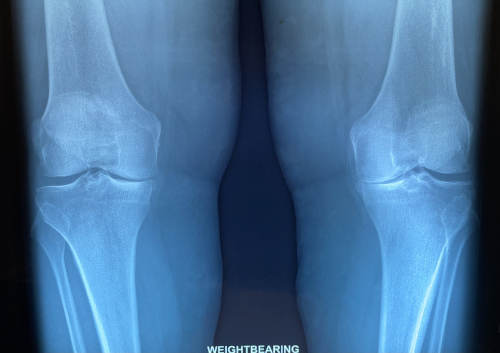
Chronic knee pain, particularly Osteoarthritis, has long been a condition that has bewildered the medical world. Until recently, it had been established that advanced wear and tear of the cartilage within the knee joint was the reason for the pain. This has now been challenged because bone and cartilage do not have sensory nerves to feel pain (Illustration 1: Only the left was painful!) So, what is producing the pain? 20 years ago I worked informally on a method to resolve knee pain in the presence of a Baker’s Cyst. In recent years, my technique (The Invisible Knee Technique) has now demonstrated that the cause of ALL chronic knee pain is due to the presence of excessive swelling (inflammation). This paper reports on the outcomes of using The Invisible Knee Therapy on patients who presented to myself with knee pain. Overall, the general level of satisfaction and effective pain relief was as high as 97% across all the presentation groups. It has also enabled me to deduce the source of knee pain… sensory nerves and the role they play.
Trial Technique and Treatment
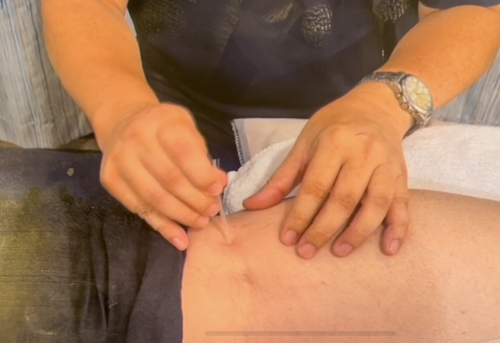
The therapy involves acupuncturing the back of the knee (Illustration 2), then massaging the calf and the Popliteal Fossa of the knee to stimulate circulation. Over a period covering September 2022 to May 2024 every patient presenting with knee pain (with the exception of post–surgical) generally received two 30min sessions per week. After 3 weeks, the patients would either continue twice weekly or reduce to weekly based on their response. The goal was to determine how effective the treatment was to resolve pain.
Results
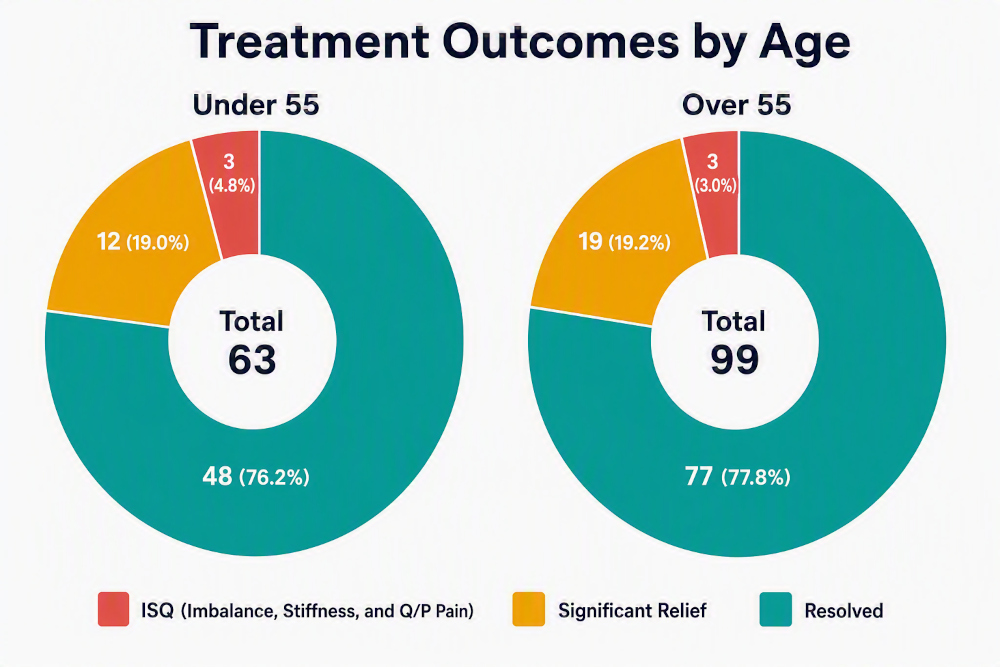
Analysis 1: A total of 162 patients were identified over the observed period and grouped by age (<55 years and ≥55 years). Clinically meaningful improvement or complete pain resolution at discharge was reported in up to 96% of cases across both groups.
Treatment outcomes: Age
| Group | IKS | ISQ | Sig Relief | Resolved |
| Under 55 | 63 | 3 | 12 | 48 |
| Over 55 | 99 | 3 | 19 | 77 |
| Totals | 162 | 6 | 31 | 125 |
Combining the results of the Resolved Patients with the Significant Relief was clinically important due to the number of visiting patients from out of town and were only available to attend for 1 or 2 sessions. There positive responses were valuable. No patients were required to undertake an exercise programme to strengthen the legs nor try and lose weight to aid their pain relief.
The Over 55 age group yielded a 96% favourable outcome. Those who were able to walk continued to do so. Others opted to take it easy to prevent further inflammation during the course of the treatment. Most patients had a very good range of movement; full extension is important for good knee mechanics. They were allowed to continue their normal activities. Only 3 patients were ISQ. They either declined Acupuncture or had other extra-articular injuries. (1 opting for surgery).
Within the Under 55 Age Group the result was 95% favourable outcome when combining the results. On assessment, most patients were negative on McMurray testing. Others have a history of a meniscal tear in the past and the knee flared up running.
Analysis 2: Subjects were also later classified according to their presentation history, Osteoarthritic, Trauma or Insidious knee pain.
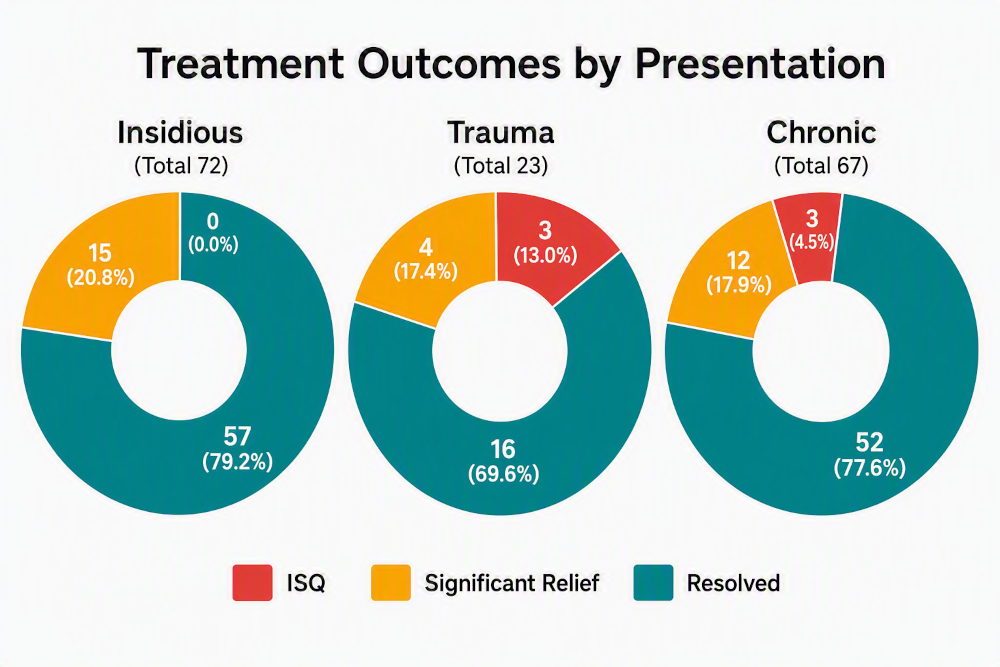
The rationale for this analysis was created based upon the overall results. Almost half of patients presenting had no idea as to why their knee was hurting (Insidious Group 100%). These included patients who had had scans. The Invisible Knee Therapy reduced swelling that was not observable. The Trauma Group (83%) included patients who fell, twisted their knee or anything that was forceful. Some had a recent history of meniscal tears within the previous month. The majority of the Chronic Group (97% effective) were diagnosed by GPs and presented with OA. The Invisible Knee Therapy was able to demonstrate its effectiveness by presentation.
Treatment outcomes: Presentation
| Group | IKS | ISQ | Sig Relief | Resolved |
| Insidious | 72 | 0 | 15 | 57 |
| Trauma | 23 | 3 | 4 | 16 |
| Chronic | 67 | 3 | 12 | 52 |
| Total | 162 | 6 | 31 | 125 |
Graphic Representation of Outcomes
Outcome: Patients averaged around eight treatments before pain resolution. They were not instructed to do any special exercises to strengthen their muscles nor advised to lose weight. In Most cases, they were also able to maintain their normal activity throughout their care.
Discussion and Concept of Pressure Theory
Patients undertaking the Invisible Knee Therapy had a high compliance because of its simplicity. No exercise programme, no weight control required. They were given advise on management to minimize recurring episodes and told to live life as normal. The outcomes were so consistent that data collection was stopped prematurely prior to the planned 3 years.
This paper has demonstrated the effectiveness of the Invisible Knee Therapy in resolving knee pain regardless of age or presentation. The results challenge the notion that exercises and weight control are directly influential on pain management. It also challenges the notion of a “premature OA” for the younger patients. Patients presenting with Traumatic injurie s to other structures such as Co-lateral ligaments demonstrated that the knee joint will also need to be accounted. It significantly highlights the insight into the contribution of the sensory nerves in the presentation of both acute and chronic knee pain.
Sensory nerves such as Mechanoreceptors play a major role in pain production that has been overlooked. Structures such as the Ruffini Endings, Merkel Cells are slow adapting nerves that help with touch. They are very sensitive and are able to detect distention and pressure at very small levels (enabling the blind to read Braille). These nerves are also present in the skin that surrounds the knee, especially the posterior. Amounts so small that they are not observable to the naked eye (Hence The Invisible Knee Syndrome), but one can feel! Being slow adaptors means that constant stimulation of the nerve results in continuous output, leading to a change in character…pseudo-Pain nerve! Joint swelling exerts an outward force on the nerves. This is why people often get relief wearing pressure supports. Imagine sitting on a wood chair. Ok initially, but after 10min it becomes painful!
The knee then is a highly tolerant hydraulic system. It can take forces that allow us to walk, jump and take weight without pain. But just like the pressure within the tyres of planes, faults will lead to damage. In the case of knees, it’s too much intra-articular pressure, or overinflation leading to pain.
This paper is not a formal study nor completed with an advanced statistical analysis. The reality is that this paper was written by a Clinician with over 30 years of experience demonstrating the viability of the concept of the Invisible Knee Syndrome and its implied role of articular fluid dynamics. Currently patients of age presenting to doctors will be diagnosed as having OA and thus begins the journey that will in time end with a knee replacement. Patients undertaking the Invisible Knee Therapy do not question the method of this paper, they judge by outcome.
Footnote: Since the initial implementation of this treatment in 2022 anecdotal follow-ups with local OA patients has seen the majority not requiring ongoing treatment, even after a year, because they haven’t re-injured their knee.