
Do you wake up with a stiff neck, tight shoulders or a headache? Your pillow may be contributing to the problem.
At On Path Physio, we often discuss sleeping posture with patients experiencing neck pain. Choosing the right pillow is not about buying the most expensive brand. It is about finding the right height and support for your body and sleeping position.
1. Side sleeping: Get the pillow height right
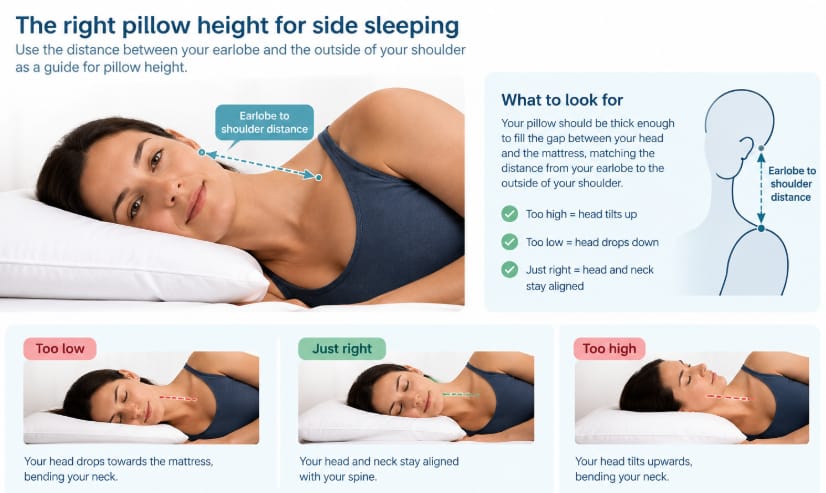
When sleeping on your side, the pillow needs to fill the gap between your head and the mattress.
A useful guide is to take note of the distance between your earlobe and the outside of your shoulder. Your pillow should support this gap without pushing your head too high or allowing it to drop towards the mattress.
- Too high: Your head tilts upwards, bending your neck sideways.
- Too low: Your head drops towards the mattress, also bending your neck.
- Just right: Your head and neck remain comfortably aligned with your spine.
Your shoulder width, mattress firmness and how much the pillow compresses will all affect the height you need.
Where should your head sit? Your head should rest comfortably on the pillow, with support beneath the base of your skull and neck. Keep your shoulder on the mattress rather than resting on the pillow.
2. Back sleeping: Support your neck naturally
When sleeping on your back, your pillow should support your head and the natural curve of your neck.
- A pillow that is too high may push your chin towards your chest.
- A pillow that is too low may allow your head to tilt backwards.
- The right height should feel comfortable without forcing your neck into a position.
Some people prefer a contoured pillow, while others find a regular pillow works best. Comfort and support matter more than the pillow’s shape.

3. Stomach sleeping: Be mindful of your neck
Stomach sleeping usually requires you to turn your head to one side for breathing. Holding this position for hours may aggravate existing neck stiffness.
If possible, try gradually transitioning to side or back sleeping. If you continue sleeping on your stomach, a thin pillow may help reduce additional neck bending, providing it feels comfortable.

4. Does pillow thickness and material matter?
Yes. Different materials compress differently, affecting how much support your head receives.
- Memory foam: Moulds around your head and neck.
- Latex: Often retains its shape and provides responsive support.
- Fibre or down pillows: Can be soft but may flatten overnight.
- Contoured pillows: Provide shaped neck support but may not suit everyone’s body.
Remember that a soft mattress allows your shoulder to sink further, while a firm mattress may require a higher pillow. Always test your pillow on your usual bed.
5. What if you still wake up with neck pain?
A suitable pillow can improve comfort, but neck pain may also be related to desk work, driving, muscle tension or stiffness in the neck and upper back.
At On Path Physio, we assess the underlying factors contributing to your symptoms and provide individualised treatment, which may include hands-on physiotherapy, movement advice and exercises.
If your neck pain persists, affects your sleep or limits your daily activities, a physiotherapy assessment may help identify the cause.
The On Path Physio pillow checklist
Before buying a new pillow, ask yourself:
- Does it fill the gap between my head and mattress when side sleeping?
- Does it keep my head comfortably aligned with my spine?
- Does it support my neck without pushing my head forwards or backwards?
- Do I feel comfortable, both when falling asleep and waking up?
The bottom line
The best pillow is the one that suits your body and sleeping position. For side sleepers, use the distance between your earlobe and shoulder as a starting point for choosing pillow height. For back sleepers, look for comfortable support beneath your head and neck.
If you regularly wake with neck stiffness or shoulder tension, the team at On Path Physio can help you understand what may be contributing to your symptoms and find practical ways to improve your comfort.
Visit onpathphysio.com.au or call (02) 9189 1337 to book an appointment.